Sue has been a School Psychologist in a school district for quite a number of years so it’s not uncommon for her to see current or former students when she is out and about. It’s problematic now that she can’t recognize faces. Some people may not have appreciated what was said but luckily Sue and I have good senses of humor and I can see a cartoon here, can’t you?!
Sue is obviously an exercise enthusiast (aka ‘nut’ to some of us who are not ::grin::). Before her vision loss, she didn’t have to think as much about what she can and cannot do as she has to now. She’s had to consider that there will be things she can’t do. Even so, at least in MY book, she is indeed…
One of the things that people with low vision can do is to learn not only how to use what vision they have but to use the other senses as well. Sue ordered a monocular which is like half of a binocular so that not only can she listen to the birds, she can use it to see them as well.
One of the things I hear people say often is something like “the research on that is [pick one: interesting/great/confusing/promising]”. Have you ever tried to read a research article that is written in a ‘scientific’ format? When I was in college in the dark ages, I was in a field where I wrote them and read them a lot but in the years since then I didn’t need it. When it came time to start the website with Sue and share information based on research, I had a tough time. I still do with some of them (I have not yet made it all the way through the scientific paper on AREDS2). Here’s a GREAT article.
There are 11 steps & I especially like the last one: “11. FINAL STEP: (Don’t neglect doing this) What do other researchers say about this paper?”
You may have heard the phrase “Is this the hill you want to die on?” and assumed it was referring to military operations. Sue tells us why it’s a question we need to ask ourselves when we are faced with choosing our own battles.
Happy New Year! We hope that 2017 is a HOPEFUL and healthy year for you and yours.
This page certainly wasn’t planned to be published today considering that Sue wrote this in August, but many people at the end of the year are thinking of starting fresh. I subscribe to some newsletters related to ‘all things home’ from decorating to cooking – you name it. I just got a newsletter that talks about how to clean and organize the house to start the new year. Sue talks about the challenges of doing that with low vision.
The short answer to that question: not yet. There is a major problem in developing eye drops for AMD. One article states it as “Ophthalmic drugs have traditionally been administered topically, which in general provides therapeutic levels to the anterior (front) chamber of the eye but not to the Continue reading “UPDATED: Are there eye drops instead of injections to treat wet AMD?”
There are quite a few eye diseases that cause degeneration of the macula. The most common forms of macular degeneration are defined by age, at least in part: 1) Age-Related MD (AMD or ARMD) and 2) Juvenile MD (JMD) – several inherited and rare diseases that affect children and young adults including Stargardt’s Disease, Best Disease, and juvenile retinoschisis.
There is another form of macular degeneration called Myopic Macular Degeneration or Myopic Maculopathy.
What is myopia?
If you have trouble seeing things far away like road signs, your eye doctor may have said that means you are nearsighted because you can see things near better than far. Some people call it being shortsighted. The medical/optical term is myopia.
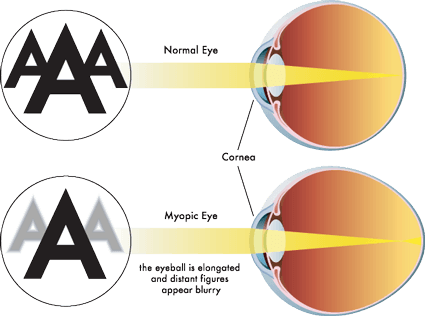
Top of diagram shows normal eye & vision. Below, myopic eye and vision.
Myopia occurs when the eyeball is too long relative to the focusing power of the cornea and lens of the eye (see diagram above). This causes light rays to focus at a point in front of the retina, rather than directly on its surface. It can also be caused by the cornea and/or lens being too curved for the length of the eyeball. In some cases, myopia is due to a combination of these factors. Click here for more information.
There are different degrees of myopia: mild, moderate and high (also called pathological myopia). The higher the degree, the higher chance of the degeneration of the macula. Click here for some other risks for high myopia including retinal detachment, macular detachment, glaucoma and macular holes.
Myopic Macular Degeneration
People with high myopia/pathological myopia are at risk for damage to the macula from the stretching of it as the eyeball grows throughout life. Here’s a good description of what happens: “As the eyeball grows and stretches, it may also cause an area of atrophy and/or cracks in the layers under the retina. These cracks can serve as conduits for abnormal blood vessels to grow under the retina. These vessels can hemorrhage and scar which is similar to what happens in wet macular degeneration. The onset of the nets of abnormal blood vessels, called Fuch’s spots, often occur in the 4th to 6th decades of life. Approximately 5% of pathological myopia patients develop Fuch’s spots, which lead to damage in the macular region of the eye and a subsequent loss of central vision.” From http://www.lowvision.org/Pathological%20Myopia.htm
Not all people who are myopic get Myopic Macular Degeneration.
Click here for an explanation of how the atrophy can occur as well as how the blood vessels grow into the macula.
The symptoms are similar to AMD & JMD as well. Click here to learn more about them. This article will take you to stories of people who have Myopic MD.
Click here for a first-hand account of the disease from a person with it.

 My Macular Degeneration Journal