Highlight: Summary of Research & Development 2018

In the 2 years that Sue & I have been doing what we do, we’ve learned from & interacted with people in the field whom we trust and respect. Dan Roberts is one of them. He has had AMD for many years & has shared his journey & developed many helpful resources. He’s an author and director of the International Low Vision Support Group, an active and much-respected organization. Every year he publishes his Summary of Research and Development.  This year’s report includes the topics:

discontinued and delayed trials
updates on continuing trials
gene therapy
combination therapies
surgical interventions
nutrition
stem cells
daily living
new technology
the future

The Future

It’s important that you read his section The Future so here it is in Dan’s words:

“Finally, let’s look at the future. The rate of research and development is moving at an exponential rate, covering many areas of treatment and daily living:

– Continued refinement of surgical techniques
– Continued successes with stem cell and gene replacement research
– Advances in pharmaceutical therapies, including development of biosimilar drugs, which equal the safety and efficacy of current drugs at a lower cost
– New ways for patients to monitor their own progress at home
– Development of systems for diagnosis and treatment via the Internet, saving time and money spent for clinical visits
– Improvements in audibility of assistive devices for those who are both visually and hearing impaired
– Increased accessibility of portable independent navigation systems for travel both outdoors and indoors
– Integration of audible speech into assistive devices

We will continue to follow all of this action throughout the coming years and keep you updated with newsletters, email news alerts, and these annual summaries. Knowledge is the best way I know of to keep the fear of the unknown at bay, making living with low vision less stressful, and acceptance a little easier. – Dan Roberts

Click here for the full report.

UPDATED: Are there eye drops instead of injections to treat wet AMD?

The short answer to that question: not yet.  There is a major problem in developing eye drops for AMD.  One article states it as “Ophthalmic drugs have traditionally been administered topically, which in general provides therapeutic levels to the anterior (front) chamber of the eye but not to the posterior (back) segment. Therefore, topical administration of drugs has been largely infeasible for posterior segment diseases such as AMD and diabetic macular oedema.  In contrast, intravitreous injection [for wet AMD] provides direct delivery to the posterior segment and allows therapeutic levels to be attained.”

Here are the studies so far (there is other research that I’m not including that is currently only being done with animals).  Keep in mind that there are four phases to clinical trials.  Click here for more information about clinical trials.

  • PAN-90806/Panoptica: topical Lucentis
    • clinicaltrials.gov Phase I completed
    • “A phase I/II trial of the next generation of the formulation is set to begin in the first and second quarters of 2017.” Click here for an article.
  • OHR-102 (originally “Squalamine”): squalamine has been shown to interrupt and reverse the process of angiogenesis; used in conjunction with Lucentis injections, goal is to reduce number of injections or eliminate them.
    • clinical trials phase III not recruiting subjects,  completed in mid-2019.
    • click here for an article.
    • Temporary suspension of clinical trial phase 2, not due to safety issues.  Going forward with phase III.  “Effectiveness: Unfortunately, Squalamine Eye Drops failed to decrease the average number of Lucentis injections required by the study participants. This was the primary goal of the clinical trial and the result was disappointing, both to researchers and to people with wet AMD, who were hoping that Squalamine Eye Drops could possibly reduce, or even eliminate, the need for eye injections.”
  • CPP: cell-penetrating peptide (CPP) can be used to deliver therapeutically relevant doses of ranibizumab (Lucentis) and bevacizumab (Avastin)
    • University of Birmingham, England
    • click here for an article.
    • “This is exciting for both patients and practitioners,” said Dr. Jayanth Sridhar, assistant professor of clinical ophthalmology at the Bascom Palmer Eye Institute. “But this was a preliminary study in animal eyes only. Further research must be undertaken in human subjects first to establish safety, and then to establish effectiveness. Still, this study offers at least a glimmer of hope that in the coming years we may see a topical drop option emerge to supplement or replace injections.”
  • OC-118: “solubilizing nanoparticle” technology
    • Article Jan. 6. 2018 says “This technology, the company hopes, can boost the drug’s ability to reach the front and the back of the eye — something that previous drugs haven’t achieved unless delivered via needle to the eye.” It is currently being looked at to treat Diabetic Macular Edema (DME). I couldn’t find anything to confirm or deny that it could be used to treat AMD.

Updated & verified 1/8/2018

Highlight: What foods should I be eating for good eye health?

Nutrition for Good Eye Health – the Basics

Disclaimer

Eye Healthy Nutrients

Click here for a good place to start to learn about aspects of nutrition that have been recommended for good eye health.


<–Click on the photo for a larger image.

Click here for more details from AOA (American Optometic Association) about this infographic.


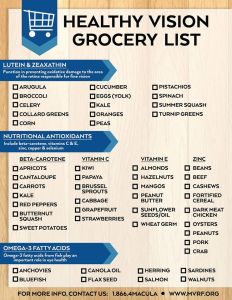
Click here for a printable grocery list.


Diet Plans for Good Eye Health

            • not listed in any particular order; we aren’t making any recommendations & we make no money on the sale of any of the products below.
            • Macular Degeneration Diet and Prevention Plan by Dr. Stuart Richer, OD, PhD, Ocular-Nutrition Laboratory in DVA Medical Center Eye Clinic, North Chicago, IL
            • Eyefoods has a diet plan that you can learn about in their book, on their website, Facebook page or blog
            • Eat For Your Sight Cookbook from the AMDF (American Macular Degeneration Foundation), the cookbook is available here or through amazon.com
            • Mediterranean Diet for eye health
            • Anti-inflammatory Diet
            • Cure AMD, proposed eating plan (based on ‘ancestral diet’) to prevent AMD and reverse it in its early stages.  I’ve corresponded with the author & expressed my concern about his use of the word ‘cure’.  He said he believes so strongly on his research that he could not use any other title.

      • Disclaimer:  We have a standard disclaimer that no one reads ::smile:: so I just want to remind you that we say in it:
        • Any information, books, products or any other materials at My Macular Degeneration  Journal/ey are not intended to treat, diagnose, cure or prevent any disease, disorder or health condition, and is provided for educational purposes only.
        • Always consult your doctor with eye health questions about your specific medical conditions and before starting any diet, exercise, or supplement program.

Go to the Top

Highlight: Here’s a GREAT website especially for those with wet AMD

Lin/Linda here: Every once in a while I find a website and/or Facebook page that stands out.  Here’s one of those.

The website and Facebook page are called The Science of AMD: Our vision is to save your vision.  It is presented by the Amgiogenesis Foundation. Their headquarters are in Cambridge, Massachusetts.


Click here to go to the website. From there, you can connect to Facebook, Twitter or YouTube using icons in the upper right corner.


What is angiogenesis? From the website: “Angiogenesis is the process used by the body to grow blood vessels. In healthy adults, normal angiogenesis occurs in healing wounds and reproduction, but in all other situations, it is abnormal.”

It’s what causes wet AMD: “Wet AMD is caused by abnormal angiogenesis, when new vessels grow under the macula, disrupting the central region of the retina. These new blood vessels bleed and leak fluid, causing the macula to bulge or lift up from its normally flat position, impairing central vision. If left untreated, scar tissue can form, and central vision is irreversibly lost.” 

What’s so special about the website?
  • From a design standpoint, you can change the size of the font and the color of the font & background, you can choose a version of the site in any of 7 languages as depicted by flags, it’s easy to navigate.
  • Format of content includes printed text, videos, audio, graphics, PDF files and more.
  • This is not just for the US, there are resources available for other countries as well.
What information can I find there?

There’s a menu with Learn, Treat, Resources, Connect, About, Donate.  I suggest you start at Learn!   The emphasis is on how angiogenesis causes wet AMD and what can be done to treat it.

OK, now go and explore! Let me know what you think!

Highlight: There’s so much research out there but how can I understand a research paper if I’m not a scientist?

Great question!

One of the things I hear people say often is something like “the research on that is [pick one: interesting/great/confusing/promising]”.  Have you ever tried to read a research article that is written in a ‘scientific’ format?  When I was in college in the dark ages, I was in a field where I wrote them and read them a lot but in the years since then I didn’t need it. When it came time to start the website with Sue and share information based on research, I had a tough time. I still do with some of them (I have not yet made it all the way through the scientific paper on AREDS2). Here’s a GREAT article.

There are 11 steps & I especially like the last one: “11. FINAL STEP: (Don’t neglect doing this) What do other researchers say about this paper?”

How to Read and Understand a Scientific Paper: a Guide for Non-Scientists

UPDATED: Are there eye drops instead of injections to treat wet AMD?

The short answer to that question: not yet.  There is a major problem in developing eye drops for AMD.  One article states it as “Ophthalmic drugs have traditionally been administered topically, which in general provides therapeutic levels to the anterior (front) chamber of the eye but not to the Continue reading “UPDATED: Are there eye drops instead of injections to treat wet AMD?”

Highlight: Is there a connection between drugs taken for osteoporosis and wet AMD?

Click here for the article “A Troubling Link Between osteoporosis Drugs and Macular Degeneration.”   There MAY be a link but this article says “Despite the finding, Dr. Etminan, a pharmacological epidemiologist in the Department of Ophthalmology and Visual Science, cautions that it’s too soon for people to stop using the drugs or to avoid taking them, because this is the first study to show a link. Other large-scale studies using other patient databases need to be done before drawing firm conclusions.”

Other Articles

Click here for article “Oral Bisphosphonate Use Poses Risk of Wet AMD”

Click here for article “Examining the Link Between Osteoporosis Drugs and AMD”

Click here for article “Bone Meds Fosamax Boniva Linked to Blinding Macular Degeneration”


Highlight: Why are you taking that?

June 24, 2016

I have published information about the AREDS/AREDS2 supplements in the past.  In the Facebook group, we’ve discussed the studies and the pros and cons of taking the supplements. Here’s the text of an article that I hope will clarify some of the concerns that have been expressed by eye professional.  The link to the article is at the end of this post.


A long-time patient presented for an exam the other day. This is a patient that I look forward to seeing, as we have some common interests that we chat about during his exam. He remarked that he really enjoyed coming for his exam, because he felt secure in the advice I give him. However, he also stated he has recently experienced an unsettled feeling in having to find a new primary care provider due to insurance changes.

Here’s a bit of history on this patient: He is in his mid-50s, myopic, but otherwise enjoys normal ocular health. He has a family history of age-related macular degeneration, with both his mother and maternal aunt having undergone anti-VEGF injections for wet AMD. Several years ago I measured his macular pigment optical density and found it to be very low. I prescribed a triple carotenoid supplement (lutein, zeaxanthin and mesozeaxanthin), his pigment level is now well within normal range, and he reports taking this supplement without fail. In reviewing his medications, I noticed an addition, an Age-Related Eye Disease Study 2 formula. Knowing I had not prescribed this, I asked him why he was taking it.

“Well, I was at the drugstore and saw the box. It said that it was the No. 1 doctor-recommended brand, and the only clinically proven formula, so I thought I would take this along with what you prescribed. It is only a vitamin right?”

Only a vitamin… So this patient who has stated he trusts what I recommend for his eyes has fallen prey to misleading advertising on a product label at his local pharmacy.

I asked him a few questions.

GM: Did the label state that there is no clinically proven benefit to taking the AREDS2 formula for patients without AMD or even those with mild disease, only a moderate benefit for those with intermediate to severe disease?

Patient: Well, no, it did not say that.

GM: Did the label tell you that taking large doses of zinc have been linked to the development of Alzheimer’s disease and prostate cancer?

Patient: No, the label did not say that either.

GM: Did the label state that other studies have found that vitamins C and E have no effect on the development of AMD?

Patient: No.

GM: Did the label state that high doses of vitamin E have been associated with increased risk of heart failure?

Patient: No.

GM: Did the label state that if you have the wrong genetics, the high dosage of zinc might accelerate progression of AMD?

Patient: No.

GM: Do you think I would prescribe this for you?

Patient: No, definitely not. I am throwing away the bottle when I get home!

Interestingly, 2 days after this encounter I read an announcement regarding the release of an AREDS2 formula plus a multivitamin. It was stated that the reason for the combination formula was due to the fact that 90% of participants in the AREDS2 trial that took an AREDS supplement also took a multivitamin (which in itself may have skewed the results of the trial). The piece also stated that consumer feedback and data showed that more than 50% of people older than 50 use a multivitamin.

Unfortunately, supplements do not face the same FDA scrutiny as drugs do. Consider what is seen in TV ads for drugs. The announcer lists a litany of possible side effects that the drug being advertised may have, all the while showing images of the supposed patient taking the drug playing with their grandkids or walking along a beach. Now imagine if a commercial for an AREDS formula vitamin had to do the same. Patients would likely think twice while in the drug store vitamin aisle about self-prescribing. And perhaps maybe they would ask for advice from their eye care provider.

References:

The Age-Related Eye Disease Study 2 Research Group. JAMA.2013;309(19):2005-2015. doi:10.1001/jama.2013.4997.

Awh CC, et al. Ophthalmology. 2015;122(1):162-169; doi: 10.1016/j.ophtha.2014.07.049.

Christen WG, et al. Ophthalmology. 2012;119(8):1642-1649; doi: 10.1016/j.ophtha.2012.01.053.

Leitzmann MF, et al. J Natl Cancer Inst. 2003; 95:1004-1007.\


The article above is from: http://www.healio.com/optometry/nutrition/news/blogs/%7Bcc9498b0-051f-44c9-948d-dac572140054%7D/gary-l-morgan-od/blog-why-are-you-taking-that

News: Stem Cell Clinical Trials in the UK

For Those in the UK

Click here for an article about a UK patient at Moorfields Eye Hospital in London as part of The London Project to Cure Blindness.  Click here for the press release dated September 28, 2015, that describes the ongoing project.  The patients in this study have wet AMD.  This is apparently the first study of its type in the UK.

Click here for more information about the stem cell research trials including 2 videos and a graphic illustration of where the stem cells are implanted.

Want to know more about what stem cells are, where they come from, and how they are used?

For more information about stem cell research, click here to read Sue’s page where I’ve placed quite a few links to helpful articles.  There’s also a link to the clinical trials website for the US.

For more information

News: Stem Cell Treatments – Successes, Concerns, US Legislation