Highlight: What foods should I be eating for good eye health?

Nutrition for Good Eye Health – the Basics

Disclaimer

Eye Healthy Nutrients

Click here for a good place to start to learn about aspects of nutrition that have been recommended for good eye health.


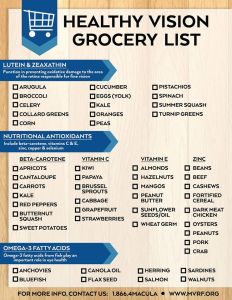
<–Click on the photo for a larger image.

Click here for more details from AOA (American Optometic Association) about this infographic.


Click here for a printable grocery list.


Diet Plans for Good Eye Health

            • not listed in any particular order; we aren’t making any recommendations & we make no money on the sale of any of the products below.
            • Macular Degeneration Diet and Prevention Plan by Dr. Stuart Richer, OD, PhD, Ocular-Nutrition Laboratory in DVA Medical Center Eye Clinic, North Chicago, IL
            • Eyefoods has a diet plan that you can learn about in their book, on their website, Facebook page or blog
            • Eat For Your Sight Cookbook from the AMDF (American Macular Degeneration Foundation), the cookbook is available here or through amazon.com
            • Mediterranean Diet for eye health
            • Anti-inflammatory Diet
            • Cure AMD, proposed eating plan (based on ‘ancestral diet’) to prevent AMD and reverse it in its early stages.  I’ve corresponded with the author & expressed my concern about his use of the word ‘cure’.  He said he believes so strongly on his research that he could not use any other title.

      • Disclaimer:  We have a standard disclaimer that no one reads ::smile:: so I just want to remind you that we say in it:
        • Any information, books, products or any other materials at My Macular Degeneration  Journal/ey are not intended to treat, diagnose, cure or prevent any disease, disorder or health condition, and is provided for educational purposes only.
        • Always consult your doctor with eye health questions about your specific medical conditions and before starting any diet, exercise, or supplement program.

Go to the Top

Highlight: Here’s a GREAT website especially for those with wet AMD

Lin/Linda here: Every once in a while I find a website and/or Facebook page that stands out.  Here’s one of those.

The website and Facebook page are called The Science of AMD: Our vision is to save your vision.  It is presented by the Amgiogenesis Foundation. Their headquarters are in Cambridge, Massachusetts.


Click here to go to the website. From there, you can connect to Facebook, Twitter or YouTube using icons in the upper right corner.


What is angiogenesis? From the website: “Angiogenesis is the process used by the body to grow blood vessels. In healthy adults, normal angiogenesis occurs in healing wounds and reproduction, but in all other situations, it is abnormal.”

It’s what causes wet AMD: “Wet AMD is caused by abnormal angiogenesis, when new vessels grow under the macula, disrupting the central region of the retina. These new blood vessels bleed and leak fluid, causing the macula to bulge or lift up from its normally flat position, impairing central vision. If left untreated, scar tissue can form, and central vision is irreversibly lost.” 

What’s so special about the website?
  • From a design standpoint, you can change the size of the font and the color of the font & background, you can choose a version of the site in any of 7 languages as depicted by flags, it’s easy to navigate.
  • Format of content includes printed text, videos, audio, graphics, PDF files and more.
  • This is not just for the US, there are resources available for other countries as well.
What information can I find there?

There’s a menu with Learn, Treat, Resources, Connect, About, Donate.  I suggest you start at Learn!   The emphasis is on how angiogenesis causes wet AMD and what can be done to treat it.

OK, now go and explore! Let me know what you think!

News: Summary of AMD Research & Developments for past 12 months – June 2016

Here’s an excellent summary of the research and developments in the field of AMD.  It’s done by Dan Roberts of mdsupport.org which is a site I highly recommend for both information and support.

Click here for the audio with slides presentation. You don’t have to be able to see the slides, the audio is very clear.

Click here for a transcript of the presentation.


Highlight: Why should I be concerned about ‘blue light’?

There’s been a lot of talk lately about ‘blue light’.   You’ve probably heard that it is bad for those who do not have AMD and also for those who do.  The question is what is it and what evidence is there that it is bad for us?

Click here for a very extensive article that:

  • explains the visible light spectrum and tells how it affects our eyes.
  • provides references to blue light research.
  • points out that our cornea & lens (refer to the illustration) filter some of the blue light and that the yellowing of the lens in the development of cataracts helps to filter out blue light.  For that reason, when the natural lens is replaced with an intraocular lens (IOL) in cataract surgery, we lose that protection.  Some doctors insert an IOL that is tinted to block blue light.   Some say that if this is done, it cuts down on our ability to adapt to dark conditions which causes some to have poor night vision.
  • explains the terms used to refer to visible light.
  • discusses the difference types of lamps with pros and cons and gives specific descriptions of what’s available.

Click here for another great article about how the violet and blue light of the UV spectrum can worsen AMD.  The article says that the sources of violet/blue light are “sun (main source), computer screen, phone & other mobile device screens, full-spectrum lighting (ie, used to treat Seasonal Affective Disorder (SAD), fluorescent lighting, LED lights, high intensity mercury vapor lamps (for night sports and high-crime areas), and xenon arc lamps.”

Click here for a more technical article that addresses the effects of blue light on sleep and eyestrain.  It also answers the questions:

  • How does blue light affect eye strain and sleep?
  • Should I block all blue light?
  • Are my eyes just sensitive to blue light?
  • What are software solutions and physical blue light filters?

What can we do to block blue light?  Here are some suggestions:

Do you spend a lot of time on the computer and other electronic devices?  

Click here for an article that describes some ways we can be protected from the blue light emitted from them. It also describes the new feature called Night Shift for the iPhone and iPad that filters some of it.  For Windows devices, there is an app Windows f.lux.  Click here to find out how to download and install it.

You can also get screen protectors and ‘computer glasses’.  I talk about them below.

Do you spend a lot of time outside?

You need to wear sunglasses that filter out the blue light from the sun. Click here to go to a post about how to choose sunglasses.

Do you need eyeglasses or contacts?

Even if you have IOLs (the lenses implanted when cataracts are removed) that block blue light, my eye doctor told me that the amount of blue light filtered isn’t that significant so additional blocking is advised.

You can get the lenses coated to filter out blue light.  Kodak Bluelight Reflect is one. Crizal Prevencia is another.  Click here for other products. Talk to your eye doctor or optician about what they offer.

As far as coating for contacts, that’s available also.  This article talks about tinting for cosmetic reasons but there is also a section that talks about adding a UV coating to them. At the time this article was published, they said none of them should replace sunglasses with good UV filtering. To be honest, I don’t yet know if you can have blue light coating on contact lenses.

Do I need special ‘computer glasses’?

If you do not wear eyeglasses or wear them but don’t have a good protective coating on them, you might consider a pair of glasses with protective coatings but no prescription to reduce glare and blue light transmission.  Even if you have IOLs (the lenses implanted when cataracts are removed) that block blue light, my eye doctor told me that the amount of blue light filtered isn’t that significant so additional blocking is advised.

Click here for a good article about what computer glasses are and how they work.

Can I filter blue light from my electronic devices without specially coated eyeglasses, contacts or ‘computer glasses’?

Yes, you can buy screen protectors for your devices.  Click here for a very extensive discussion of them.

Do you need cataract surgery?

Talk to your doctor about the tinted IOLs that can be inserted (refer to first article above or click here).

What kind of indoor lighting do you have?

Again, the first article above gives a great overview of the terms used to refer to visible light & discusses the different types of lamps with examples.


  • Neither Sue nor I get any commissions from any of the products included here.

Highlight: When should I get my eyes checked?

Did you recently get a diagnosis of AMD?  Was it such a shock that you don’t remember much about what the doctor told you about when to get your eyes checked?  Or did you not discuss it at all? The latter situation is all too common.  Of course, a lot of that depends on the type of AMD (dry or wet) and the severity.  It is VERY IMPORTANT that you treat any vision loss as an emergency.  Call your eye doctor as soon as possible.

Here’s a great video showing how an eye doctor should examine your eyes and how he/she would be able to detect AMD.

In the video, the narrator states that everyone who is 60 and older should have a comprehensive dilated eye exam once a year. Of course, if you are having problems you should NOT wait a year, call for an appointment as soon as possible.  However, if you are at higher risk due to race, age or family history of AMD, that may mean you will see your eye doctor more often.

Between eye exams, you should be monitoring your own vision using an Amsler grid on paper or on a computer, tablet or smartphone.  Here is a great article explaining the importance of home monitoring and showing an Amsler grid, where to get one, and how to use it. It also describes the ForeseeHome Monitoring Device which is connected to the doctor’s office.  Click here for that article.


News: CVS faces lawsuit for claim about a store-brand eye product

April 10, 2016

For those who have intermediate and advanced AMD, doctors recommend the nutritional supplement that came through 2 NIH research studies: AREDS & AREDS2.  If you haven’t already done so, please read our post What about those eye vitamins?

The only product that has all the nutrients from the AREDS2 study is made by Bausch + Lomb PreserVision. CVS put their store brand supplement next to this one and labeled it “comparable to ongoing study formula in AREDS2.” A 91-year-old woman was diagnosed with AMD and the doctor prescribed the PreserVision product but because of the label, she switched to the CVS brand because it was half the price.

It is NOT comparable.  To read the whole story, click here.